Tractor-Mounted Earth Auger vs Manual Labour for Plantation Pit Digging in India
Every large-scale plantation in India has the same first problem: the pits.
Whether you are establishing a 200-bigha mango orchard in UP, a teak plantation block in MP, a coconut farm in coastal AP, or an agroforestry eucalyptus block for a paper mill in Telangana — before a single seedling goes into the ground, someone has to dig hundreds of uniform holes.
The old way is still the most common way: contract a team of daily-wage labourers with spades and iron rods, mark the spots, and dig. It works. It has always worked. But it is slow, inconsistent in depth, expensive per-pit, and brutally hard on the workforce in peak summer months.
There is a better option — and it has been in the agricultural implement market for decades. It just has not been marketed directly to horticulture contractors the way it should be.
What Plantation Pit Digging Actually Requires
Before comparing machines, it helps to understand what a plantation pit actually needs to be. The specifications vary by crop, but the general range across Indian horticulture is as follows:
| Crop | Typical Pit Size | Spacing | Pits Per Hectare |
|---|---|---|---|
| Mango (dense planting) | 0.6 m × 0.6 m × 0.6 m | 8 m × 8 m | 15–18 |
| Mango (large pit method) | 1 m × 1 m × 1 m | 8 m × 8 m | 15–18 |
| Teak | 0.45 m × 0.45 m × 0.45 m | 2 m × 2 m | 230–250 |
| Coconut | 1 m × 1 m × 1 m | 7.5 m × 7.5 m | 17–20 |
| Eucalyptus | 0.3 m × 0.3 m × 0.3 m | 2 m × 2 m | 230–250 |
| Sugarcane (pit method) | 0.3 m × 0.3 m × 0.3 m | 0.9 m × 0.9 m | ~1,200 |
On a 100-hectare teak block, that is roughly 25,000 pits. On a 500-hectare eucalyptus plantation, you are looking at north of 100,000 holes.
Manual labour does not scale to those numbers efficiently. It never did.
The Manual Labour Reality
Let us be direct about what manual pit digging actually costs and delivers.
A skilled labourer with a spade and crowbar in good loamy soil can dig approximately 8 to 15 standard pits per day (0.45 m depth, 0.3–0.45 m diameter). In hard or gravelly soil — common in parts of Vidarbha, Bundelkhand, and the Deccan plateau — that drops to 4 to 8 pits per day.
A typical plantation contractor running manual labour for pit digging:
And that assumes a consistent, reliable labour force — which is the other problem.
The Labour Availability Problem
Post-MGNREGS, agricultural wage labour for hard physical tasks like pit digging has become increasingly unreliable at scale. In peak planting seasons — the pre-monsoon window from March to May when most horticulture pits need to be ready — every contractor in a district is competing for the same labour pool simultaneously.
A plantation scheduled for June planting that depends on 60–80 labourers being available consistently from March to May is a plan built on uncertainty.
How a Tractor-Mounted Earth Auger Changes the Calculus
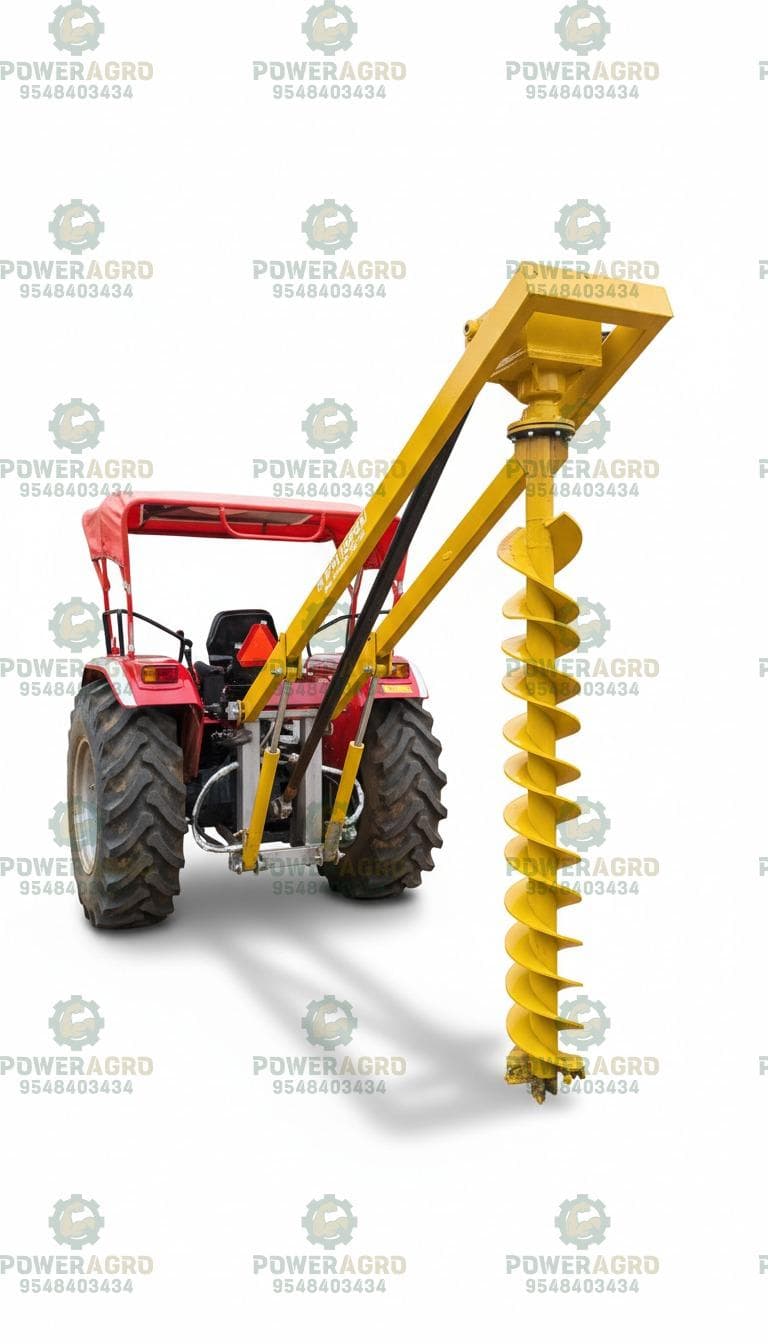
A tractor-mounted post hole digger — a PTO-driven hydraulic auger — drills a circular pit in one continuous vertical cutting pass. There is no manual effort. The tractor's PTO shaft spins the auger at 540 RPM, the auger flights carry the spoil upwards and deposit it beside the hole, and the machine moves to the next marked spot.
Speed Numbers That Matter
In typical Indian agricultural soil (loamy alluvial, black cotton in dry season, mixed laterite-loam):
For a 5,000-pit teak block, that is 12 to 25 working days with one auger-tractor unit. With manual labour at 10 pits/worker/day, the same block requires 500 worker-days — roughly 25 workers for 20 days, if you can assemble and hold them.
Depth and Diameter Consistency
When labourers dig 5,000 pits over several weeks, there is substantial variation in depth and shape. For commercial plantation species where uniform root depth and soil loosening directly affect early establishment and survival rates, inconsistent pit dimensions translate into variable seedling performance — which shows up 6 months later in uneven growth across the block.
A tractor auger delivers the same depth and diameter on every hole — controlled by how far the operator lowers the 3-point linkage. Set the hydraulic depth stop once, and every pit in the block is identical.
Choosing the Right Auger for the Crop
Mango, Coconut, and Large Fruit Trees
Standard recommendation is a 1 m × 1 m × 1 m pit for full-vigour rootstock in good soil. An 18-inch (450 mm) auger on the Hydraulic Jack model gets you the diameter. Depth of 2.5 to 3 feet is achievable with the standard non-jack model; a full 1-metre depth is within range with the hydraulic-assist version in normal soil.
Recommended: Hydraulic Jack Model (18-inch auger, up to 8–9 ft depth), operated at 3–3.5 ft setting for plantation work.
Teak, Sagwan, and Timber Plantation
Standard teak pits run 45 cm × 45 cm × 45 cm. A 12-inch (300 mm) auger on the standard Non-Jack model covers this precisely. The circular profile of the auger hole is actually better for young teak roots than the rectangular hand-dug pit — it avoids hard compacted walls on the sides.
Recommended: Standard Non-Jack Model (12-inch auger, 4–5 ft depth), operated at 1.5 ft setting.
Eucalyptus and Fast-Growing Timber Blocks
Eucalyptus pits are small (30 cm × 30 cm × 30 cm) but are required in enormous quantities. A 9-inch (230 mm) auger moves fast, and at 1-foot depth settings the standard model drills 400+ pits per day in loamy alluvial soil.
Recommended: Standard Non-Jack Model (9-inch auger), optimised for high-volume low-depth work.
The Two Models
Standard Non-Jack Post Hole Digger (Starting Rs 60,000)
This is the right choice for 80% of plantation pit digging in India. Most horticulture and forestry pit depths are 0.6 to 1.0 metres — well within this model's operational range.
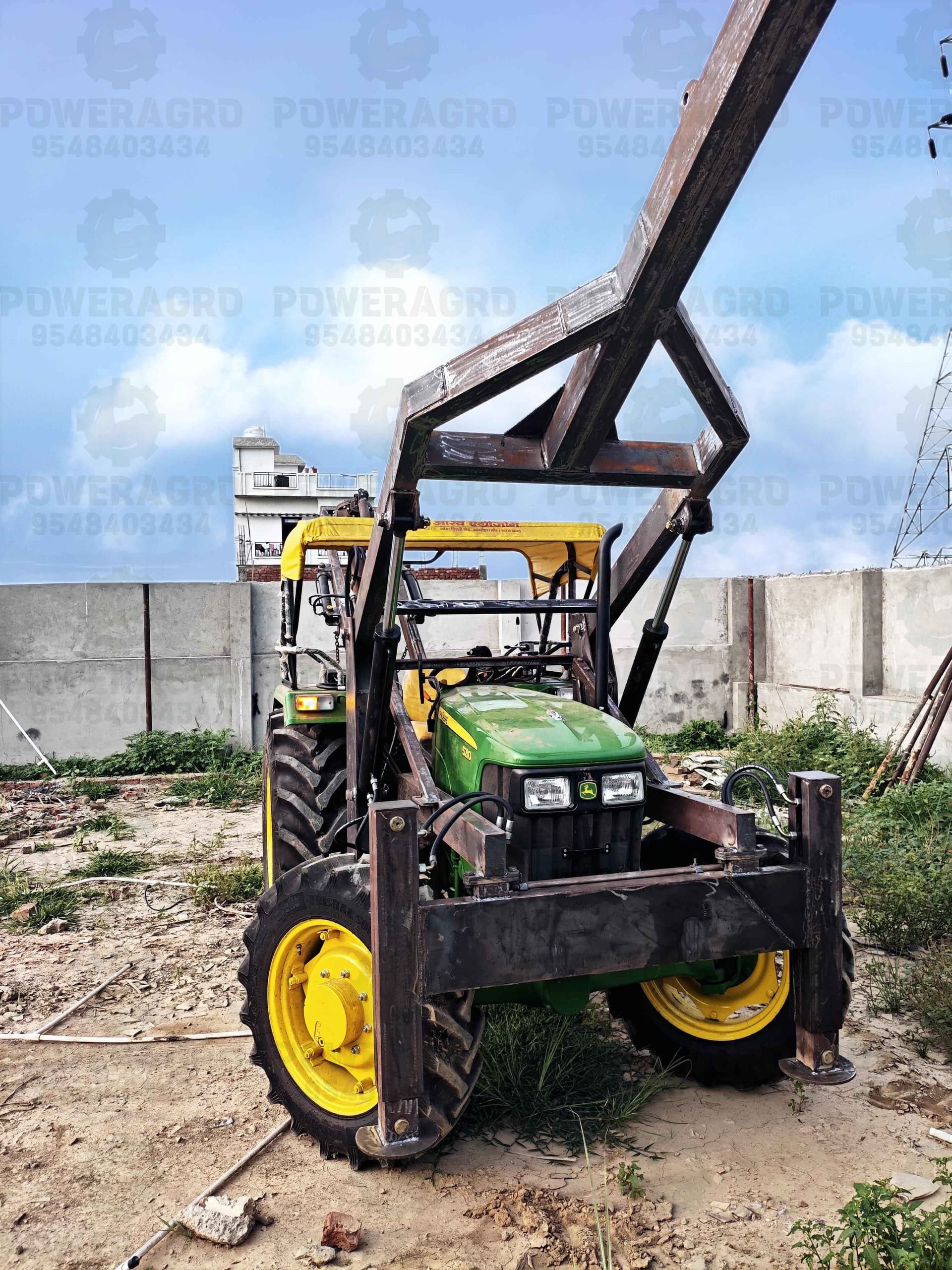
Hydraulic Jack Post Hole Digger (Starting Rs 1,20,000)
The hydraulic model's downforce advantage is significant in hard or gravelly soils where the standard model's penetration rate drops.
A Real Comparative Calculation: 1,000-Tree Mango Orchard
Pits required: approximately 1,000 (0.6 m × 0.6 m × 0.6 m pit, standard 8 m × 8 m spacing on 6.4 hectares)
Manual Labour
PowerAgro Standard Non-Jack Auger (12-inch)
Labour savings on this one project: Rs 47,667. The machine pays for itself in under two comparable projects.
Soil Conditions Across India's Plantation Geographies
UP and Bihar (Alluvial, Indo-Gangetic Plain): Near-ideal for the standard model. High output rates, low bit wear. The heart of India's mango and sugarcane country — the standard 12-inch non-jack model handles this perfectly.
MP and Chhattisgarh (Mixed Loam + Laterite for Teak): Works well in loamy zones. Laterite-heavy areas see speed reduction — plan for 150 to 200 pits/day in hard laterite. Replaceable hardened teeth are essential.
Maharashtra and Telangana (Black Cotton Soil): Dig in the dry season (Oct–May). Black cotton expands when wet and resists initial auger entry. The 12-inch auger is better than 9-inch in BC soil for clean walls. The hydraulic model is recommended for particularly sticky plastic black cotton.
Konkan, Coastal AP/TN (Coconut and Areca Nut): Coconut pits are large — 1 m × 1 m × 1 m is standard. The hydraulic 18-inch model is the right tool here. Sandy coastal soils make drilling easy.
Rajasthan (Sandy Desert Fringe, Agroforestry): Extremely fast drilling in sandy soil. The standard 9-inch or 12-inch non-jack model produces its highest output rates here. Ideal for eucalyptus and khejri agroforestry programmes.
Odisha and Jharkhand (Laterite Uplands): Use the hydraulic model for laterite-dominant blocks. Expect 100 to 150 pits/day — still dramatically faster than manual methods.
Beyond Pit Digging: Full Utilisation Across the Farm
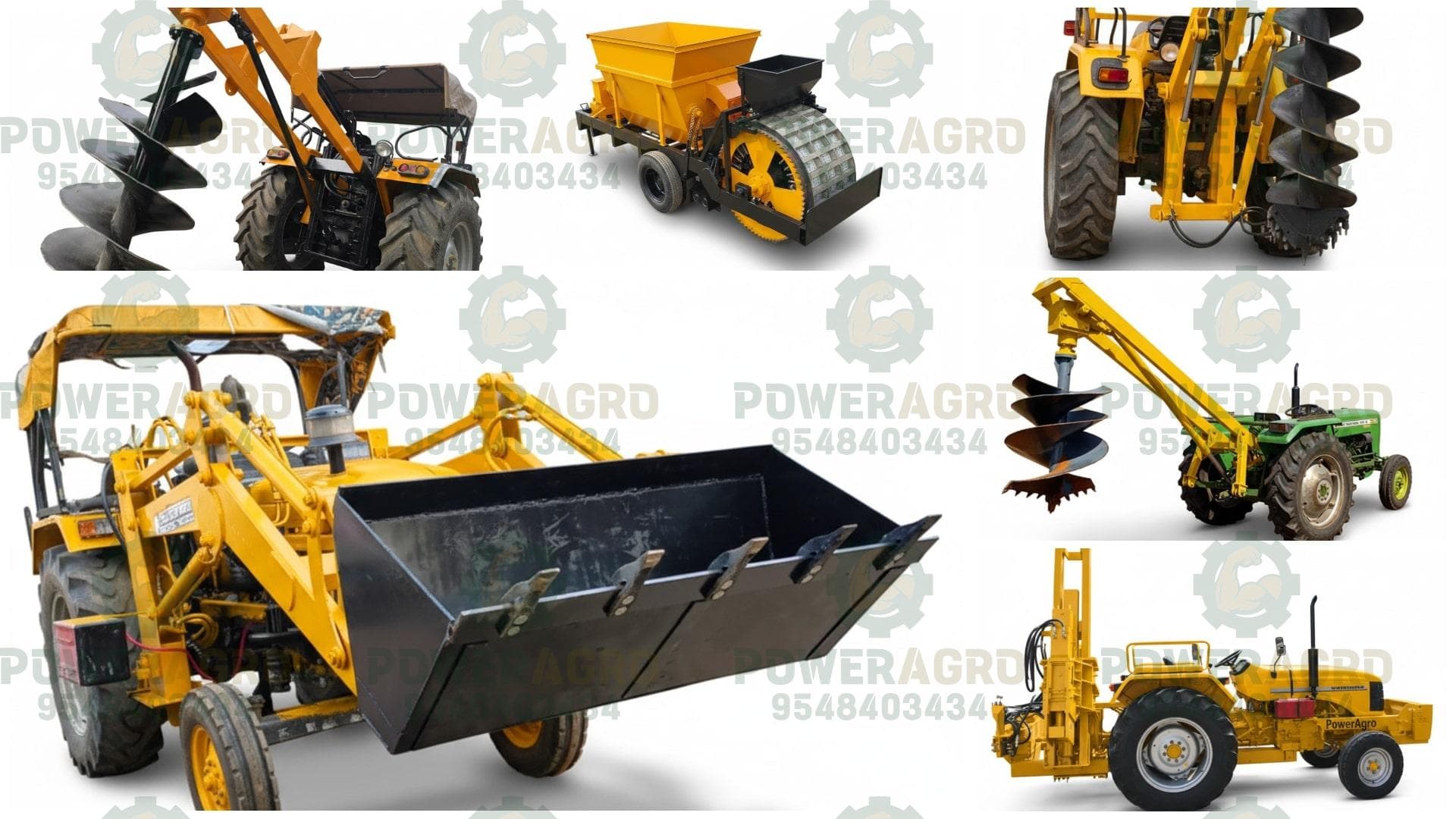
The same attachment handles:
A plantation contractor running several hundred acres annually will find the machine busy across the full planting cycle, not just the 2-month pit digging window.
Frequently Asked Questions
Q: Can the tractor auger handle rocky or gravelly subsoil common in many plantation regions?
A: Yes, with caveats. The auger flights carry loose rock and gravel out with the spoil. Where the problem is bedrock or large embedded boulders, no auger drills through — the same limitation applies to manual digging. For sites with scattered stoniness, inspect and replace the hardened-tip teeth every 200–300 pits in stony ground versus 400–600 pits in loamy soil.
Q: What is the smallest tractor that can run this attachment?
A: The Standard Non-Jack Model works effectively from 25 HP — which includes common small tractors like the Mahindra 265 DI, Swaraj 724, and Eicher 241. Most farmers already own 35 HP+ tractors, so compatibility is rarely an issue on plantation sites.
Q: Can we use this for sugarcane pit method planting at close spacings?
A: Yes — the 9-inch auger at 1-foot depth is a fit for sugarcane pit spacing. The tractor's turning radius at tight spacings (0.9 m × 0.9 m) means the operator should plan the drilling sequence row-by-row to avoid wheel tracks on completed pits. In practice, a systematic row-by-row pattern works well.
Q: How long does it take to attach and detach from the tractor?
A: The 3-point linkage attachment takes 5 to 15 minutes depending on the operator's familiarity. After the first few setups, experienced operators typically complete it in under 10 minutes.
Q: What maintenance does the machine need during the planting season?
A: Gear oil level check every 50 operating hours. Inspect auger teeth after every 200–300 pits in abrasive soils — replace individual teeth as they wear. Check all fasteners weekly in field conditions. The gearbox is sealed and oil-bathed.
The Bottom Line
Plantation pit digging is the most labour-intensive, time-sensitive step in orchard and forestry establishment. It has to happen in a specific window, at scale, and the quality — depth uniformity, sidewall condition — has a direct agronomic impact on seedling establishment and survival rates.
Manual labour delivers the work eventually. But "eventually" is not a practical answer when you have a June planting window and 25,000 pits to dig.
A tractor auger at Rs 60,000 starts paying back on the first large project. By the third or fourth plantation block, the machine cost is fully recovered and every subsequent project runs at dramatically lower cost per pit.
---
Planning a plantation and need to spec the right auger?
Talk to our team directly:
For large-volume plantation work, send a WhatsApp message with your crop type, soil description, and approximate pit count — we will advise on the right model and whether the standard or hydraulic variant fits your site better.