How a $4,000 Machine from India Can Help Solve Africa's Electrification Crisis
Export Information
Direct from manufacturer — Khatauli, Muzaffarnagar, UP, India
There is a number that should stop anyone working in African development in their tracks: 600 million.
That is how many people across the African continent still have no access to electricity -roughly half the entire population. And of those 600 million, more than 80% live in rural areas where extending the national grid means planting poles, kilometre after kilometre, across terrain that no truck can easily reach.
The machinery to do that work fast and safely exists. It has been used in India for years to electrify villages at a scale that African utilities could only dream of. And today, it can be shipped to your port for under $3,700 USD.
This is the story of how a simple, tractor-mounted hydraulic machine from a small manufacturer in Uttar Pradesh, India could meaningfully accelerate rural electrification across sub-Saharan Africa -and why no government or contracting team working on pole installation should ignore it.
The Real Bottleneck Is Not Money. It Is Speed.
Financing for rural electrification in Africa has never been more available. The World Bank, African Development Bank, USAID, and dozens of bilateral donors have collectively committed hundreds of billions of dollars to energy access programs. And yet, progress has stalled.
Between 2010 and 2020, electrification rates improved rapidly. Since 2020, the pace has flatlined - and in several countries, rural access has actually worsened in absolute terms because population growth is outrunning grid expansion.
The real bottleneck is installation speed.
In most rural African contexts, erecting a single utility pole involves:
1. A labour crew of 5 to 8 workers
2. Manual digging of a 2-metre hole using picks, shovels, and augers hand-turned by multiple men
3. Manhandling a 200–400 kg prestressed concrete or wooden pole into the hole
4. Backfilling, compacting, and levelling -all by hand
5. Repeating this process dozens of times per day, per crew
On good flat soil, a skilled crew might plant 8 to 12 poles per day. On rocky laterite soil, clay, or waterlogged ground -which describes much of rural East and West Africa -that drops to 4 to 6 poles per day.
At that rate, electrifying even a single 10-kilometre rural feeder line with poles at 50-metre spacing requires 200 poles -or roughly 20 to 50 working days of labour for a single crew. Multiply that across an entire district and you begin to understand why Africa's rural electrification timelines routinely run years behind schedule.
What a Tractor-Mounted Pole Erection Machine Actually Does
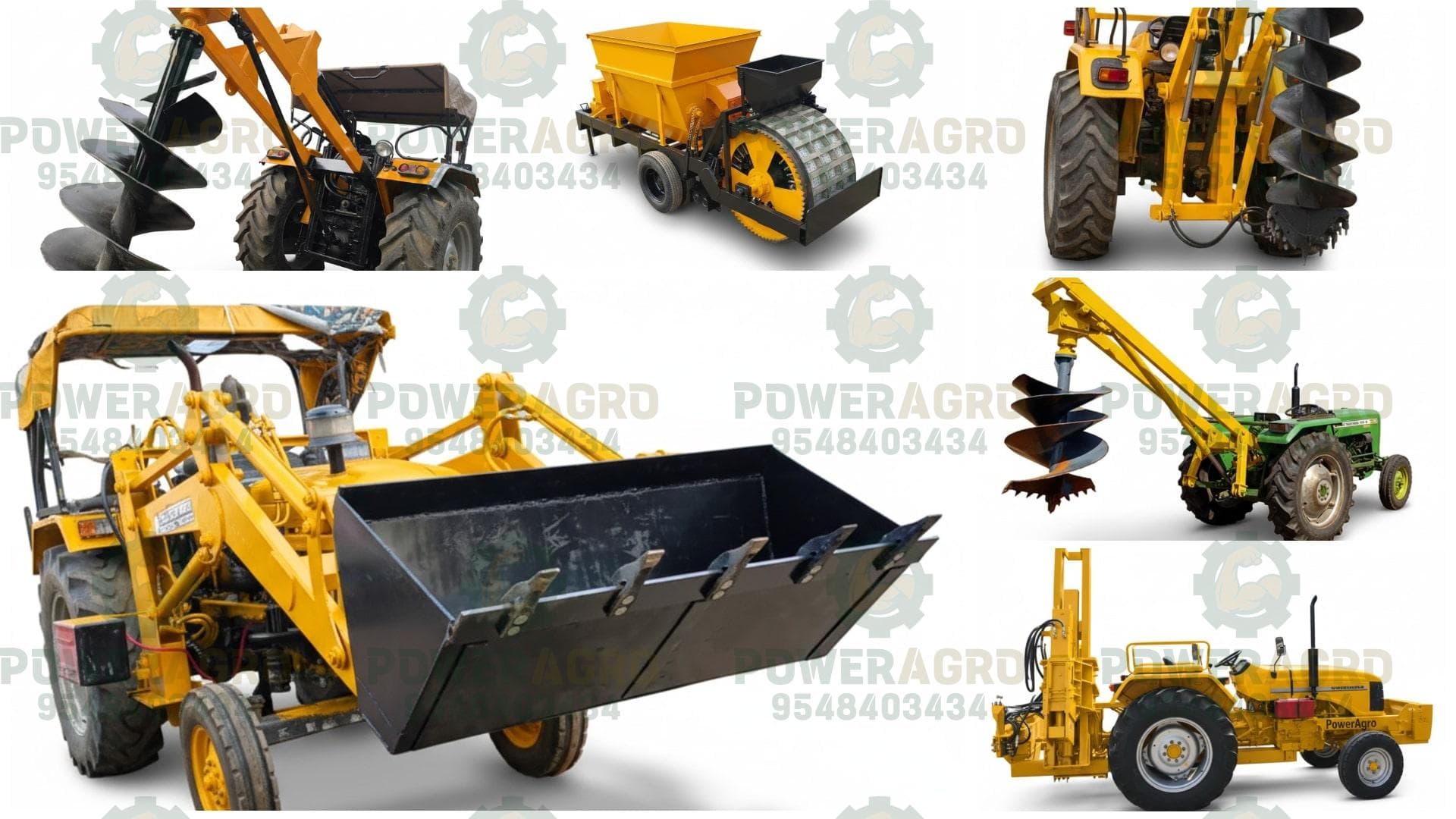
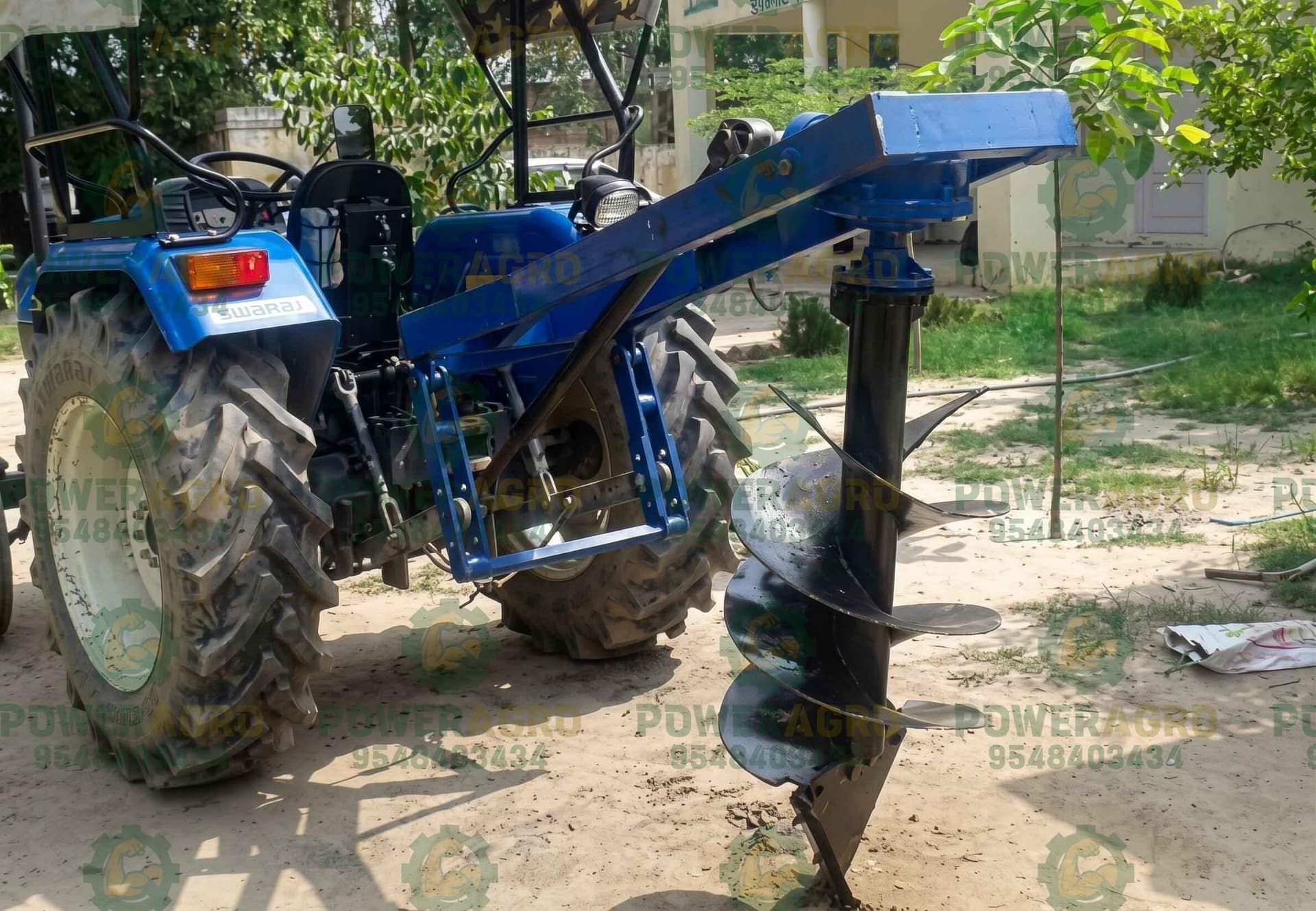
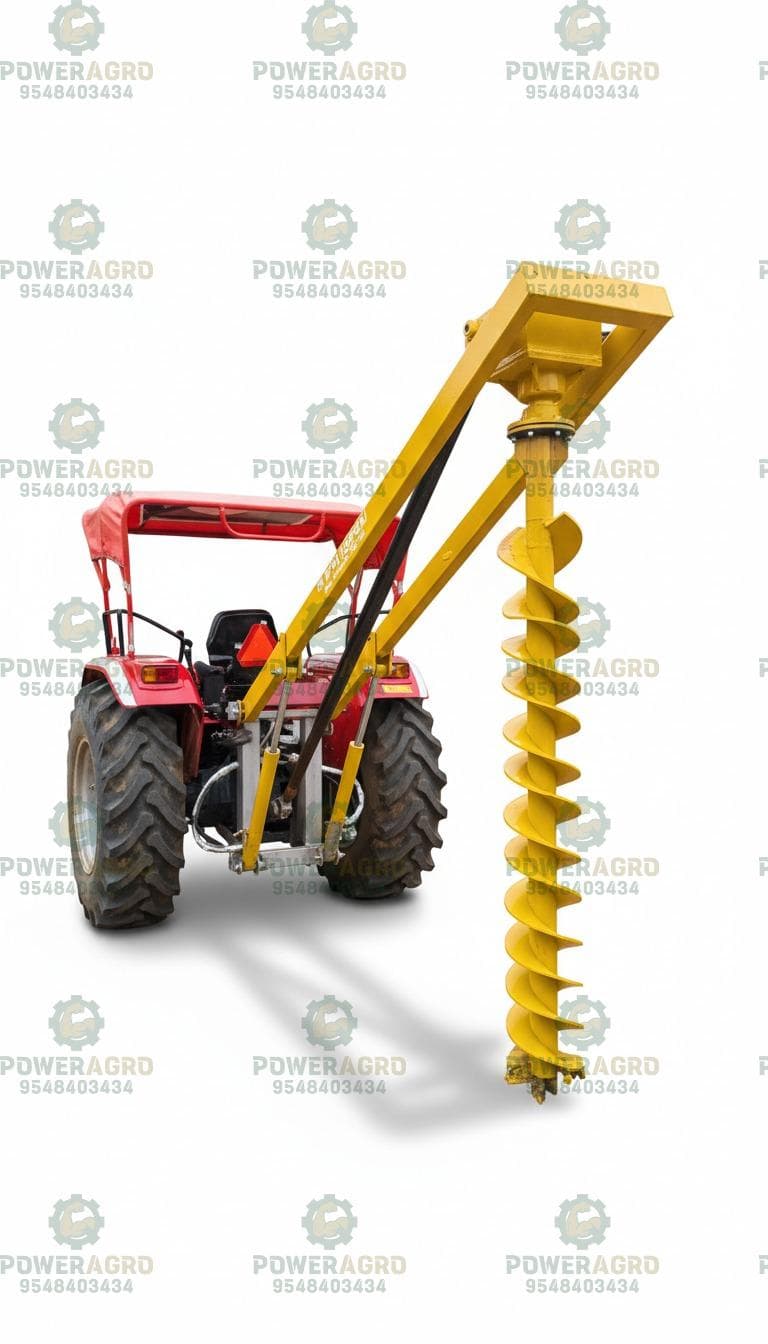
The PowerAgro Tractor Mounted Pole Erection Machine is not a complicated piece of technology. There is no software to crash, no specialist to train for months, no imported spare part that is impossible to find. It is a hydraulic boom crane and earth auger assembly, mounted on the rear 3-point linkage of any standard 35–75 HP tractor.
In a single machine, it does what used to require three separate operations and multiple pieces of equipment:
1. Digs the hole -A hydraulic auger drive motor powers a rotating auger bit into the ground. It drills to depths of up to 10 feet (3 metres) and widths of up to 22 inches (560 mm) -large enough for a standard concrete utility pole. Soil types from loamy topsoil to hard laterite clay are handled with the right auger bit selection. Rocky ground models are available.
2. Lifts the pole -The hydraulic boom extends up to 20 feet horizontally and lifts up to 1.7 metric tons. A standard 9-metre prestressed concrete pole weighing 280–350 kg is lifted with almost no manual effort. Workers guide the pole to alignment but do not bear any of its weight.
3. Places the pole -The telescopic boom extends up to 20 feet horizontally, reaching across the road shoulder to place a pole from a truck parked alongside, without needing to reposition the tractor. The dual hydraulic outrigger stabiliser legs extend and lock the tractor firmly to the ground, enabling safe heavy lifts on sloped roadsides and soft or muddy terrain.
The result: a single operator and two to three ground workers can plant 25 to 40 poles per day -a 3× to 5× improvement over a manual crew of twice the size.
The Cost Comparison That Changes the Conversation
Let us put actual numbers to this.
Manual Crew (No Machine)
With PowerAgro Pole Erection Machine
The machine pays for its own purchase price in labour savings within a single average-sized feeder line project.
On a 12-month rural electrification contract involving 2,000 poles, the saving is not incremental. It is the difference between finishing on time and finishing two years late.
Why India? Why This Manufacturer?
India has the world's most aggressive rural electrification track record. The Saubhagya scheme, launched in 2017, connected 28 million households in under 18 months -the fastest large-scale electrification programme ever completed anywhere in the world. That achievement was powered, in part, by tractor-mounted pole erection machines exactly like this one, deployed by contractors across UP, Bihar, Jharkhand, and Odisha.
PowerAgro Industries is based in Khatauli, Muzaffarnagar District, Uttar Pradesh -the same industrial corridor that supplied equipment for India's own grid expansion. The machines are not built for export showrooms. They are built for the field conditions that Indian contractors actually face: flooded paddy field roads, black cotton soil, broken laterite tracks, and 45°C summer heat.
Those conditions are not so different from what electrification crews face in Nigeria's Middle Belt, Tanzania's Tabora Region, or Zambia's Copperbelt Province.
What Is Included in the Machine
The flagship export model -the PowerAgro PMX-22M (Model: PA-PEM-22-A-MAX) -includes:
FOB India Price Range: $2,400 – $3,700 USD depending on configuration (standard 3-jack model to full 7-jack auger model).
Tractor Compatibility for African Markets
The machine mounts on any standard Category I / Category II 3-point linkage tractor. This covers the most common tractor brands operating across Africa:
If your country's electrification programme already has a tractor fleet, you do not need to purchase a new prime mover. The pole erection attachment simply mounts on what you already own.
Shipping to Africa -Ports, Lead Times, and Logistics
We regularly export equipment to African ports. Here is how it works:
Port of Dispatch: Nhava Sheva (JNPT), Mumbai -India's largest container port, with weekly vessel departures to all major East, West, and Southern African ports.
Transit Times (approximate):
| Destination Port | Transit Time |
|---|---|
| Mombasa, Kenya | 18 – 22 days |
| Dar es Salaam, Tanzania | 20 – 24 days |
| Durban, South Africa | 22 – 26 days |
| Lagos, Nigeria | 24 – 28 days |
| Tema, Ghana | 25 – 29 days |
Container Loading: Two complete pole erection machine sets (with auger) can be disassembled and loaded into a single 20-foot container to minimise per-unit shipping cost. For bulk orders (3+ units), a 40-foot container provides significant freight savings.
Documentation: We provide full commercial invoice, packing list, certificate of origin (India), and technical manual in English for all export shipments. HS code for customs clearance: 8430 (Other Boring or Sinking Machinery).
Payment Terms: TT (Telegraphic Transfer), LC (Letter of Credit), or CAD (Cash Against Documents). 30% advance + 70% against Bill of Lading copy.
Who Is This Machine Right For?
This machine is a direct fit for:
Frequently Asked Questions
Q: Can the auger drill through African laterite and red clay soil?
A: Yes. The hydraulic auger motor delivers high torque specifically suited to hard, compacted soils including laterite, red clay, and decomposed granite -common across East and West African terrains. For very rocky ground (basalt, granite outcrops), we recommend the tungsten carbide-tipped auger bit upgrade, available as an optional add-on.
Q: What if I do not have a compatible tractor in my fleet?
A: A standard 45–55 HP tractor with hydraulic output is sufficient for the standard model (PMX-22S). If you need help sourcing a compatible tractor locally, we can advise on brands and models available through African dealers. Alternatively, we can help connect you with Indian tractor exporters shipping to your country simultaneously.
Q: How does maintenance work after purchase?
A: The machine uses standard international hydraulic components -hydraulic cylinders, seals, directional control valves, and steel hose fittings -all available locally in any country with a basic hydraulic parts supplier. The PTO gearbox uses standard gear oil. We supply a full spare parts kit (cylinder seals, hose ends, pin-and-bush set) with every export order. For major components, we ship via DHL with delivery in 5–7 working days globally.
Q: Can the machine erect pre-cast concrete poles, wooden poles, and steel poles?
A: Yes. The boom-mounted lifting hook accommodates all pole types. For wooden poles, we include a standard lifting chain. For concrete poles, we supply a pole grip clamp that wraps around the pole body for a secure lift without cracking. Steel poles are handled with a shackle and lifting lug.
Q: What is the warranty and what happens if something breaks?
A: Every PowerAgro export machine comes with a 12-month warranty on structural fabrication and hydraulic components (excluding consumable seals and pins). Our engineering team is available via WhatsApp video call for remote troubleshooting. In 95% of field failures reported by our Indian customers, the issue was resolved remotely within 2 hours.
Q: Is this machine suitable for SWER (Single Wire Earth Return) rural grid pole installation?
A: Yes. SWER poles are typically lighter (8m–9m wooden or treated poles, 80–150 kg) and shallower foundation depth (1.2m–1.5m). The PMX-22S standard model handles SWER installation very easily. The auger depth and diameter can be controlled to match your design specifications precisely.
Q: How many machines should a contractor operating a 50-person electrification team purchase?
A: For a field team of 50, we would typically recommend 3 to 4 machines. Each machine supports 1 operator and 2–3 ground crew. With 4 machines running simultaneously, a 50-person team can plant 100–160 poles per day -enough to complete a 200-pole feeder line in under 2 days.
One Machine. One Tractor. One Team. Ten Times the Output.
Africa's electrification challenge is not a technology problem. The poles, the wire, the transformers -all of that exists. The challenge is doing the physical work of installation fast enough, with enough reliability, at a cost that donors, governments, and contractors can sustain.
A crew of seven men with picks and shovels is not the answer. A $500,000 hydraulic crane truck that cannot navigate a dirt track is not the answer.
A $3,200 machine that bolts onto a tractor you already own, digs the hole in minutes, lifts the pole from the truck, and places it precisely -with three workers -that is the answer.
Ready to Request a Quotation or Technical Datasheet?
Contact our export team directly:
We respond to all international inquiries within 24 hours. For urgent project requirements, please send a WhatsApp message with your country, required quantity, and target delivery timeline.